Thursday, August 26, 2010

building a syallabus for early modern book history


I've spent a good portion of my summer thinking about how to revise my syllabus for the early modern book history seminar I teach. This fall will be the sixth time I've taught this course, and while it's been working well, it's also time to shake it up a bit. Too much familiarity with the material doesn't breed contempt, but it can lead to a complacency. I've been browsing in the stacks, reading new finds, and thinking about what I want students to learn and how best to achieve that.

There are some key factors that shape how I approach teaching this course. First, it's a multi-disciplinary course, drawing students from different majors, primarily English and History, but also French, Art History, Theology, and Music. Because it's important that all these students feel welcome in and learn from this course, it cannot be too oriented toward any single subject. On the other hand, it is a course at the Folger Shakespeare Library and one that draws on the strengths of the Library's collections; that means that the focus of the course is explicitly early modern, concentrating on the last fifteenth century through the end of the seventeenth. The last major consideration in shaping this course is that its purpose is to provide students an opportunity to do hands-on research with rare materials.

Rather than moving through the period chronologically, or through some haphazard thematic pile-up, I decided from the course's first incarnation to foreground the methodological differences in thinking about books and their histories. The syllabus is organized in three units: the first considers books as physical objects, the second studies the relationships between books and culture, and the third explores books as vehicle for texts. (Actually, because it appeals to my corny sense of humor, the syllabus isn't divided into units but volumes, along with a preface and an introduction; there are actually also some interludes, but I really need to find a book-centric metaphor for those.) In many ways, these approaches sync up with disciplinary interests: analytical bibliography, history, and textual studies. Leslie Howsam's great book on Old Books and New Histories: An Orientation to Studies in Book and Print Culture is tremendously useful in thinking through the disciplinary orientations of the field which is, after all, a big mash-up of approaches and histories. To a large degree these separate frameworks are fictional: you can't think about books and culture without knowing something about the process of making a book, nor the other way around. But dividing the syllabus this way keeps the issue of how we think about books front and center, an especially useful tactic when we are also trying to think about how we are not thinking about books.

That tactic is only useful if students are aware of it, so we begin the course with a session that explicitly asks, "What is the history of books?" It features Robert Darnton's classic essay, of course, along with some D.F. McKenzie and Roger Chartier, with the three selections bearing the burden of tracing the different ways in which we might approach the field. The next session on incunabula gives students a way to start thinking about the approaches in larger terms before we get down to the nitty gritty of how books were made. We only spend a couple of weeks on this, focusing mostly on the big points: different formats and impositions, the practice of casting off and setting type, recognizing chain lines and watermarks, and differentiating between woodcuts and engravings. (Those of you in the field will recognize the quarto imposition in the image at the top of this post.) I'm not always sure how much time to devote to this. Some semesters it feels like we're spending too long (or at least, too long reading Gaskell, which is a bit of a slog and is often overkill, but is still the best thing for what I want them to learn). Other semesters it feels like we're racing through this section too fast. But if we spend longer on the physical book, that cuts into the time we have to think about books in other ways; if we spend less time, they don't know enough about the process of making books in order to ask important questions later on.

The second volume of the class moves from the physical making of books to the book trade and intersections between books, printing, culture, and economics. I structure it roughly around the roles of makers and users: we look at the role of printers and the Stationers Company, think about the creation and deployment of authors, and the use of books by readers and libraries. This has been the trickiest part of the syllabus to set--so many possibilities, so little time! This year I'm really looking forward to using Andrew Pettegree's new book, The Book in the Renaissance, which talks about books in exactly the right sort of blended approach and complexity for my purposes. I'm really loving this book, and it's been getting some great reviews: it's both smart and accessible and even if you're not a student in a book history course, it's well worth reading. Also, look at that beautiful cover! Other key readings come from Zachary Lesser's Renaissance Drama and the Politics of Publication, Bill Sherman's Used Books, and Ann Blair (I'm really looking forward to the arrival this fall of her new book, Too Much to Know, which, like Pettegree's book, is coming out from Yale and, also like his, is priced at a reasonable $45 for a hardcover). There's also some more Chartier and Darnton, mixed in with a small dose of Foucault and de Certeau, of course. The real payoff of this section, however, comes in the interplay of the readings with the students' research projects: the readings model different ways of thinking about the questions being raised, but the work is in making those questions and approaches useful when working with the book in hand.

The course wraps up with a couple of weeks thinking about how the material forms of books affect the transmission and reception of textual meaning. We go back to questions of printing, but this is really the textual scholarship showdown: what does an editor do? I like Robert Hume's piece on "The Aims and Uses of 'Textual Studies'" (PBSA June 2005) to start students thinking about what makes a 'good' edition, and I'm very fond of Random Clod's "Information upon Information" (TEXT 1991), which is smart and funny and outrageous. We combine those readings with a lot of looking at different examples of editing, from the more typical to the more crazy (the Middleton Collected Works is chock full of different and provocative editorial practices--and there's now a paperback edition for only $40!).

After having spent the summer thinking about how to shake up the syllabus, I've come right back to where I started: the structure of the course is still the best way to go about doing what I want to do. I've tweaked some of the readings, and I'm looking for a different set of rare materials to bring into the classroom to help us put the readings into action. But I'm actually pretty happy with how we're going about things.

There is one place that I would like to make changes, and that's in the interludes or case studies. In the second half of the course, we have a couple of sessions devoted to single topics that let us bring together all three legs of our book study triangle. In the past, we've had one class devoted to Bibles and one class devoted to Shakespeare. Both work really well for thinking about how the materiality of books shape the reception and use of texts and interact with the cultural forces at play and being generated. Plus, both give me a chance to bring some lovely books into the classroom. (And, given my training as a Shakespearean and as a performance scholar, it's fun to have a class to talk about those books and about the interplay between performance and print.) The downside, as I see it, is that both draw on ideas of The Book in ways that don't displace what is already a tendency in the class and in the field: to think in terms of books rather than other printed objects. I try to talk about this in class frequently: books are just one of the things that made up the printed output in the early modern period. Broadsheets, indulgences, and almanacks, for instance, are just some of the things that were as important as books--as Peter Stallybrass and others have pointed out, it's the printing of these ephemera that sustained early printers, not the big books that we now value. I could do a class on newssheets, and am considering that, although given my comparative unfamiliarity with that world, it does make me a bit nervous. I'm also considering focusing on some more utilitarian books instead, like school books, perhaps.

There are two other qualifications for this syllabus, which I recognize, but they remain. The first is that this really is a print-centered course. It doesn't reflect my own sense of the ways in which manuscript and print coexisted in the period and influenced each other. Part of my reluctance to bring manuscripts in has to do with teaching students paleography; as it is, I spend an hour or so doing a quick-and-dirty introduction to basic secretary hand and mixed italic. (Okay, it's not dirty; we read a letter from Henry Cavendish to his mother, Bess of Hardwick.) I also don't want to open up the focus of the class too far, or to start worrying about handling manuscripts. I do try to bring in ideas of manuscript culture in other ways, but it isn't a regular feature of the course.

The other qualification is how England-centric the class is. One of the reasons I'm pleased about having Pettegree's book to work with is that it really encompasses a much wider range of print practices. But the fact is, most of my students are working on English literature or history, and so many of the resources that we have available to us (the STC and the Stationers' Register, just to name the two biggest ones) are focused on England, thanks to scholars' long-standing fascination with Shakespeare. I'm not super happy with an England-, or even more accurately, a London-myopia but that's going to take me a while longer to change.

I'm going to continue tinkering with my syllabus, but since class starts at the end of next week, it will soon have to be done, and then you'll find it online at the Folger Undergraduate Program's homepage. I haven't talked about what sort of assignments students do, or the kinds of research they've done in the past, but there are some posts describing some of those projects, and you'll find the assignments detailed on the syllabus once it's up.

In the meantime, a quick word about the image at the top of this post: It's the front and back of an issue of a 1648 newspaper, The Moderate. If you download the images (follow this link) and print them on the front and back of a regular-sized sheet of paper, you'll have your very own small-scale newspaper and folding exercise. Have fun!

Thursday, July 29, 2010

false endings

I've been thinking a lot recently about the experience of reading. Part of this is about the technologies of reading, but part of this is about the nature of reading and processing words.

Some context is helpful here: this spring we sold our house and moved into a new house. As part of this process, we overhauled the old house, cleaning it out and making it look fabulously inviting (those of you who watch a lot of HGTV or live in housing-market-obsessed areas will recognize this as "staging", a term that deserves its own post on an entirely different blog). We bowed to the wisdom of our realtor, who went through our house and identified the furniture and clutter that ought to be cleared out. Right up at the top of the list were all of our bookshelves and, obviously, books. This is the point when my bookish friends yelp in horror--"Why are books unattractive?!"--but as someone who has been shopping for houses, I have to agree with the realtor on this point. Books mark a space as belonging to a specific person, someone, in this case, who is not you. If you are a Jane Austen fan, are you going to see yourself living in a space marked by Dan Brown books? I can't tell you the number of times I looked at a house and instead of being perplexed by the kitchen layout found myself thinking, "do these people really need to own so many books about football?" Equally crucial is the point that bookcases take up room--if you've got two walls lined with books, the livable space of the room feels tinier, and who wants to buy a house that is already clearly tiny and cramped? In any case, we packed up all our books. We own a lot of books. Seventy boxes of books, in fact. We packed them up in mid-April, and, for a variety of reasons having to do with renovations and the chaos of moving, those books remain boxed up and will probably stay boxed up for another six to nine months.

When I see it written down like that, I want to cry--that's a long time to go without my books! But while I miss my physical books, I have not stopped reading. But instead of buying books, or checking books out of my library (that's a different problem I won't go into here), I now read e-books on a variety of devices: Kindle, iPad, iPod Touch. And, it turns out, I love reading on these devices. I love that with the Kindle app I can start off reading a book on a Kindle, transfer it to my iPod, and sync it so that my son can devour his own novel on the Kindle while I'm at work. At night I can read on my iPad, with grey words glowing on black background without ever waking my husband, The Alpha Gadgeteer (it's thanks to him that we have this plethora of devices). And, oh, the seduction of being able to think of a book you'd like to read, buy it, and start reading it seconds later!

This isn't a post about the pros and cons of e-books and the readers that are out there, however. Rather, I've been struck by some of the differences between the experience of reading on the iPad and reading a book. For starters, and this continues to catch me out, when I'm reading on the iPad I have no sense of the passage of travel through the narrative. What I mean is, if I need to go back to double-check something that happened earlier, I have no sense of how many screens back it is--I'll think it's just a couple of finger swipes, but it's really a couple dozen swipes. The same thing happens at the end of the book--I have no idea how close to the end of the story I am. Is this seeming wrap-up of the action the false ending that lulls you into a calm before Jason bursts up from the lake and the last survivor has to take him on yet again? (I know I've mixed my book and movie references there, but that moment in Friday the 13th continues to haunt me, decades later. Perhaps it's the glossiness of the iPad that makes me think about movies; that and the fact that I've been reading lots of thrillers on it.) With a book in your hand, you have a sense of how many pages are left before the narrative wraps up, assuming that it's not a cliff-hanger or that the end of the book isn't padded with the opening chapters of the next book in a series. With the iPad Kindle app, there is no continuously visible marker of passage though the text. You read until you done, and you know you're done because you swipe your finger and the cover appears. (Yes, the cover. The app begins the book on what it thinks is the first page of main text, which means that in some books, you have to go backwards until you get to the start of the prologue.)

This realization that I don't know where I am in the forward movement of the story points to something oddly old-fashioned about reading this way, something that James O'Donnell has noted, too:
The Kindle is great for reading the way ancient Greeks read, on papyrus scrolls, beginning at the beginning, proceeding linearly, getting to the end, absorbed in one book, following the author's lead.
While the technology delivering the text is new-fangled, the reading itself is decidedly not. (O'Donnell, who is a classicist and Provost of Georgetown University, knows something about how ancient Greeks read; he has a short piece about his Kindle in the Chronicle of Higher Education, from which the above is quoted. He also delivered a talk at Yale's Sterling Memorial Library on "A Scholar Gets a Kindle and Starts to Read" this past April which you can watch on YouTube.)


I expect I'll adjust to the newness of the iPad and will someday no longer be caught out by the surprise of a story ending before I realize it. And I certainly don't always want to read in this linear fashion (there's a reason why I've been reading the type of fiction I have on it, but not any of the scholarship that I otherwise read). But for right now, it's fun to experience reading in a different way.


This is a pretty short and easy post as I try to get back in the habit of blogging again. I hadn't meant to be gone for so long, but sometimes life gets in the way (see that whole packing/selling/buying/moving drama above). As the fall approaches I am again thinking about early modern books, how to teach book history, and how to marry new technologies with old books. For the couple of you who might have hung in there during my long absence, it's nice to see you again, and I'll do better by you in the future!

Sunday, January 31, 2010

quick iPad roundup

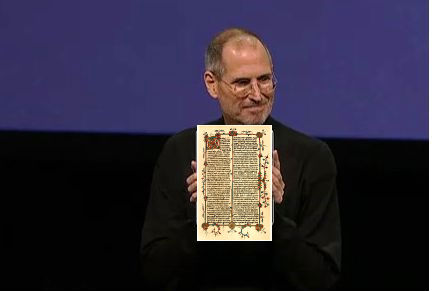
As you are undoubtedly well aware, Steve Jobs unveiled the newest Apple money-suck toy product on Wednesday: the iPad. The most immediate response was to its tone-deaf name. I don't actually find feminine hygiene products to be disgusting, but it's hard not to laugh at jokes about iTampons or iKotex. That last joke really works best with medievalists; for everyone else, you need to spend so long explaining what a codex is, that the frog has been dissected and dead long before they know what to laugh at. But even aside from menstrual jokes, the best joke I've seen comes from a medievalist. Tom Elrod's blog post, "Introducing the iCodex," captures the breathless adoration of Steve Jobs's fans and the rediscovery of reading technology.


This image from the blog captures what's smart and funny about it, as does this excerpt:
With the iCodex, people can now store multiple items in one, easy-to-use package. A user could, for example, enjoy both cooking recipes and psalms, or mappa mundi and instructions on marital relations. Since the iCodex's pages are bound together in an easy-to-turn format, things stored at the end of an iCodex are as easy to access as the beginning.
You need to go read the whole thing in full to appreciate it. Go, I'll wait here.

After that, when you're ready for some serious responses to the iPad, check out Alex Payne's response, which focuses on the iPad not as an e-book, but as a very small and slick personal computer. As an e-book it might work well, but in a way that disturbs Payne deeply: "The iPad is an attractive, thoughtfully designed, deeply cynical thing. It is a digital consumption machine." As he goes on to discuss, turning a notebook into a tool for consumption rather than creation has implications for the future of hacking and programming and, I would argue, for the ways in which familiarity with computer languages retreats even further into the hands of a small few. Payne's argument is worth considering, especially in light of what I discussed in my last post about the ability to create mash-ups, whether in book form or in music. Consumption is great, but it's creation that makes a technology stick and a culture grow. (On the flip side of Payne's argument, Daniel Tenner praises the iPad for exactly these features: Apple is "making a slick “uncomputer” that’s tailored to those people who don’t actually need a computer.")

A couple of last notes: I found most of these posts through Twitter, thanks to @MagBaroque, @academicdave, and @briancroxall. Finally, the jokes connecting computers and medieval books have been around for a while. I've posted this before, and many of you will have already seen it, but I still love it, so I leave you with the Medieval Help Desk:

Sunday, January 17, 2010

early modern mash-ups


In my last post wondering about important book history tools developments of the last decade, I got some interesting suggestions about what else to consider. For me, they came together as part of a way of remembering how advances or shifts in technology enable different ways of studying and creating knowledge and arts. In response, I've been thinking about mash-ups. Peter Friedman commented on my post that a reconsideration of authorship has been developing in part as a response to new technological tools. I'm not sure I see the correlation quite like that, at least in the field of literary studies, as opposed to his field of law. But I do agree that the availability of powerful computing tools to shape and reshape preexisting creations does reshape notions of authorship as individual ownership. EMI's anger over Danger Mouse's Grey Album (the 2004 mash-up of the the Beatles's White Album and Jay-Z's The Black Album) certainly tells us a lot about the complications in controlling what can be done and not done in the name of owning art (it also says a lot about the fine mess the record industry is in these days).

But the growing interest in and the plethora of music and video mash-ups speaks to me more as being about how the availability of technology deeply affects (and effects) our responses to art. We can talk all we want about how something like dj erb's Hollaback Girl of Constant Sorrow reflects a post-modern (or is that post-post-modern?) notion of authorship and female sexuality and the American past, but what strikes me is how technology makes possible new expressions of creativity and their distribution. Without recording technology that separates instrumental and vocal tracks and without the availability of computers to remix those tracks with other tracks unintended by the first creators, none of this would be possible. The tools that enabled artists to create their music also enables listeners to turn into artists, modifying that music in ways that honor it, subvert it, and most of all make it our own.

Now what, exactly, does this have to do with early modern books? We have all, I think, started to at least pay lip service to the notion that all early modern plays were collaborative efforts, drawing on the talents and influences of (often) multiple playwrights, players, and company sharers. (Even Shakespeare collaborated! Shh, don't tell Harold Bloom!) We are also, I hope, increasingly aware that all printed works were also collaborations, shaped by writers, publishers, and printers. But I also believe that all printed works were also collaborations with their readers. This isn't just a belief in response response theory. It's a belief that the users of books reshaped them as they needed to, sometimes literally. As Jeffrey Todd Knight makes clear in his recent--and excellent--article in the Fall 2009 issue of Shakespeare Quarterly, early readers of Shakespeare's plays and poems combined them with other printed works to create self-shaped anthologies. Part of Knight's point is that early modern readers bound works together in ways that suggest contexts and connections that have now been lost to us, as later collectors ruthlessly prioritized Shakespeare over other writers and disbound such groupings in order to rebind Shakespeare as a solitary work. It's an important recognition for those of us interested in early printed books and in the histories they accrue in the hands of collectors and libraries. Shakespeare was not separate from his contemporaries, but part and parcel.

One thing that I take away from Knight is that such context been lost. So, too, has the sense that books are made by their users. We might want to think of these gatherings as early mash-ups: books that readers remade into their own books. The technology of printed books allows for such mash-ups. Books can be joined together because they are (particularly smaller formats) sold unbound, requiring their owners to choose whether or not to have them bound and how to have them bound. The comparatively cheap cost of printed books, as opposed to manuscripts, meant that there were enough being sold and bought that such collections proliferated.

The image at the top of this post is a manuscript listing of the contents of such a collection (catalog record; zoomable image). It identifies fifteen plays and entertainments, including works by Carew, Chapman, Heywood, Jonson, and Shakespeare. Knight discusses it in his article, along with a number of other examples. (You can read the abstract of his essay; if you have access to Project MUSE, you can read the article itself online.) If you'd like to read some other musings along these lines, Whitney Trettien has a series of posts on cut-ups at diapsalmata that think not only about early modern instances, but about modern cut-ups as well.

Since I started off with my look back at the last year, I leave you with this: DJ Earworm's mash-up of the United State of Pop 2009. Enjoy!

Wednesday, December 23, 2009

UPDATE: commenting problems FIXED!

UPDATE: w00t! I think I've now solved the commenting glitch by returning to the hideous pop-out comments as opposed to embedded comments. The important thing is not the beauty of the design but that you can share your wisdom with me! So please do!

You can ignore what follows, except that if you find you are having problems, please email me at the address given below so that I can try to fix it!

I think the blogging powers that be are angry with me for being a once-a-month poster! But whatever the reason, there's some sort of bug affecting the ability for some of you to sign in and leave comments. Of course this happens when I've specifically asked for your feedback! I'm working on solving the problem--if any of you bloggers have had this happen to you, I'd be happen to hear your thoughts on how to fix it.

I'm reluctant to open up comments to all and sundry anonymous folks, but I do want to know what you want to add to the top ten list. So, please feel free to email me at wynken DOT blog AT gmail DOT com with your suggestions or tweet them to @wynkenhimself.

In the meantime, I'll make some sacrifices to the blogging powers (old mice? flash drives? the aroma of freshly minted e-books?) and will let you know when everything is up and running again!