Sunday, January 31, 2010

quick iPad roundup

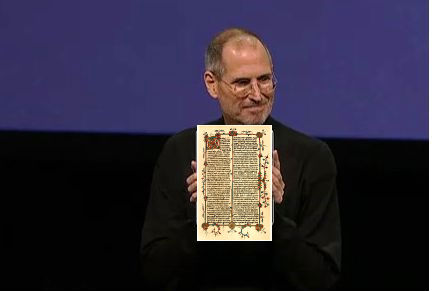
As you are undoubtedly well aware, Steve Jobs unveiled the newest Apple money-suck toy product on Wednesday: the iPad. The most immediate response was to its tone-deaf name. I don't actually find feminine hygiene products to be disgusting, but it's hard not to laugh at jokes about iTampons or iKotex. That last joke really works best with medievalists; for everyone else, you need to spend so long explaining what a codex is, that the frog has been dissected and dead long before they know what to laugh at. But even aside from menstrual jokes, the best joke I've seen comes from a medievalist. Tom Elrod's blog post, "Introducing the iCodex," captures the breathless adoration of Steve Jobs's fans and the rediscovery of reading technology.


This image from the blog captures what's smart and funny about it, as does this excerpt:
With the iCodex, people can now store multiple items in one, easy-to-use package. A user could, for example, enjoy both cooking recipes and psalms, or mappa mundi and instructions on marital relations. Since the iCodex's pages are bound together in an easy-to-turn format, things stored at the end of an iCodex are as easy to access as the beginning.
You need to go read the whole thing in full to appreciate it. Go, I'll wait here.

After that, when you're ready for some serious responses to the iPad, check out Alex Payne's response, which focuses on the iPad not as an e-book, but as a very small and slick personal computer. As an e-book it might work well, but in a way that disturbs Payne deeply: "The iPad is an attractive, thoughtfully designed, deeply cynical thing. It is a digital consumption machine." As he goes on to discuss, turning a notebook into a tool for consumption rather than creation has implications for the future of hacking and programming and, I would argue, for the ways in which familiarity with computer languages retreats even further into the hands of a small few. Payne's argument is worth considering, especially in light of what I discussed in my last post about the ability to create mash-ups, whether in book form or in music. Consumption is great, but it's creation that makes a technology stick and a culture grow. (On the flip side of Payne's argument, Daniel Tenner praises the iPad for exactly these features: Apple is "making a slick “uncomputer” that’s tailored to those people who don’t actually need a computer.")

A couple of last notes: I found most of these posts through Twitter, thanks to @MagBaroque, @academicdave, and @briancroxall. Finally, the jokes connecting computers and medieval books have been around for a while. I've posted this before, and many of you will have already seen it, but I still love it, so I leave you with the Medieval Help Desk:

Sunday, January 17, 2010

early modern mash-ups


In my last post wondering about important book history tools developments of the last decade, I got some interesting suggestions about what else to consider. For me, they came together as part of a way of remembering how advances or shifts in technology enable different ways of studying and creating knowledge and arts. In response, I've been thinking about mash-ups. Peter Friedman commented on my post that a reconsideration of authorship has been developing in part as a response to new technological tools. I'm not sure I see the correlation quite like that, at least in the field of literary studies, as opposed to his field of law. But I do agree that the availability of powerful computing tools to shape and reshape preexisting creations does reshape notions of authorship as individual ownership. EMI's anger over Danger Mouse's Grey Album (the 2004 mash-up of the the Beatles's White Album and Jay-Z's The Black Album) certainly tells us a lot about the complications in controlling what can be done and not done in the name of owning art (it also says a lot about the fine mess the record industry is in these days).

But the growing interest in and the plethora of music and video mash-ups speaks to me more as being about how the availability of technology deeply affects (and effects) our responses to art. We can talk all we want about how something like dj erb's Hollaback Girl of Constant Sorrow reflects a post-modern (or is that post-post-modern?) notion of authorship and female sexuality and the American past, but what strikes me is how technology makes possible new expressions of creativity and their distribution. Without recording technology that separates instrumental and vocal tracks and without the availability of computers to remix those tracks with other tracks unintended by the first creators, none of this would be possible. The tools that enabled artists to create their music also enables listeners to turn into artists, modifying that music in ways that honor it, subvert it, and most of all make it our own.

Now what, exactly, does this have to do with early modern books? We have all, I think, started to at least pay lip service to the notion that all early modern plays were collaborative efforts, drawing on the talents and influences of (often) multiple playwrights, players, and company sharers. (Even Shakespeare collaborated! Shh, don't tell Harold Bloom!) We are also, I hope, increasingly aware that all printed works were also collaborations, shaped by writers, publishers, and printers. But I also believe that all printed works were also collaborations with their readers. This isn't just a belief in response response theory. It's a belief that the users of books reshaped them as they needed to, sometimes literally. As Jeffrey Todd Knight makes clear in his recent--and excellent--article in the Fall 2009 issue of Shakespeare Quarterly, early readers of Shakespeare's plays and poems combined them with other printed works to create self-shaped anthologies. Part of Knight's point is that early modern readers bound works together in ways that suggest contexts and connections that have now been lost to us, as later collectors ruthlessly prioritized Shakespeare over other writers and disbound such groupings in order to rebind Shakespeare as a solitary work. It's an important recognition for those of us interested in early printed books and in the histories they accrue in the hands of collectors and libraries. Shakespeare was not separate from his contemporaries, but part and parcel.

One thing that I take away from Knight is that such context been lost. So, too, has the sense that books are made by their users. We might want to think of these gatherings as early mash-ups: books that readers remade into their own books. The technology of printed books allows for such mash-ups. Books can be joined together because they are (particularly smaller formats) sold unbound, requiring their owners to choose whether or not to have them bound and how to have them bound. The comparatively cheap cost of printed books, as opposed to manuscripts, meant that there were enough being sold and bought that such collections proliferated.

The image at the top of this post is a manuscript listing of the contents of such a collection (catalog record; zoomable image). It identifies fifteen plays and entertainments, including works by Carew, Chapman, Heywood, Jonson, and Shakespeare. Knight discusses it in his article, along with a number of other examples. (You can read the abstract of his essay; if you have access to Project MUSE, you can read the article itself online.) If you'd like to read some other musings along these lines, Whitney Trettien has a series of posts on cut-ups at diapsalmata that think not only about early modern instances, but about modern cut-ups as well.

Since I started off with my look back at the last year, I leave you with this: DJ Earworm's mash-up of the United State of Pop 2009. Enjoy!

Wednesday, December 23, 2009

UPDATE: commenting problems FIXED!

UPDATE: w00t! I think I've now solved the commenting glitch by returning to the hideous pop-out comments as opposed to embedded comments. The important thing is not the beauty of the design but that you can share your wisdom with me! So please do!

You can ignore what follows, except that if you find you are having problems, please email me at the address given below so that I can try to fix it!

I think the blogging powers that be are angry with me for being a once-a-month poster! But whatever the reason, there's some sort of bug affecting the ability for some of you to sign in and leave comments. Of course this happens when I've specifically asked for your feedback! I'm working on solving the problem--if any of you bloggers have had this happen to you, I'd be happen to hear your thoughts on how to fix it.

I'm reluctant to open up comments to all and sundry anonymous folks, but I do want to know what you want to add to the top ten list. So, please feel free to email me at wynken DOT blog AT gmail DOT com with your suggestions or tweet them to @wynkenhimself.

In the meantime, I'll make some sacrifices to the blogging powers (old mice? flash drives? the aroma of freshly minted e-books?) and will let you know when everything is up and running again!

Tuesday, December 22, 2009

the most influential book history tools of the decade

It's that time of year again. Indeed, it's that time of decade. That's right, everywhere you look, top ten lists abound. I'm not sure why we need to list ten of things we find remarkable. But it's made me start thinking: what would be on my top ten list of notable early modern book history events or tools of the decade?

Right up there at the top would have to be digitization, from EEBO to Google Books to The Shakespeare Quartos Archive. The ability to access facsimiles of works without having to travel thousands of miles, potentially saving time and money and carbon emissions and wear and tear on the books, has fundamentally changed how we conduct and teach early modern books and book history. EEBO and Google Books have been mostly about access, but Shakespeare Quarto Archive is not only about access but about developing digital tools for studying texts. (Read my posts on digitization to see some of the pros and cons I see with this development, since it's too complicated of a subject to rehearse here. Again.)

I'd say, too, that book history and early modern blogs have seen remarkable growth over the past ten years. Blogs have enabled a conversation between far-flung scholars and devotees of early books that wouldn't be otherwise possible. I've learned a lot from Mercurius Politicus and diapsalmata, as well as Early Modern Online Bibliography and Bavardess (I've learned from many others, too, and have links to them on my blog--this is just a ruthless short list of a handful that I go to the most often). They've done good things for libraries, too, opening up interest in collections and, I like to imagine, the use of our materials, across levels of scale and resources. The Beinecke has a great bunch of blogs (early modern, paleography), and I enjoy reading "Notes for Bibliophiles" from the Special Collections at the Providence Public Library. I've pleaded before for more early modern literature blogs, but I've really enjoyed what is out there, literature or not, early modern or post modern. Especially as someone who only came to this field a few years ago, I've learned a lot from reading your blogs and have been grateful for being part of this community.

This one is a bit more idiosyncratic, but watching my kids learning to read has given me a new appreciation for reading in general and for the emotional ties we have to books. Over the past ten years I've seen both my kids start reading and start loving books; I've actually also gotten to see both of them start learning Hebrew as well, which brings home the whole weirdness of written languages and learning to recognize letters as making up words and those words as having recognizable (and deployable) meanings. I continue to find the transition from gobbledygook to spoken language amazing, and the movement from spoken to written language is equally fascinating. I have one child who refused to read on his own until he had it mastered; the first book he read was The Borrowers, which is crazy ridiculous for a first-time book. My other child insisted on figuring out the reading thing before he'd even started school and made tons of mistakes along the way; those rhyming books like "Pat sat on the cat" were a key exercise for him, if a bit tedious for me. Watching them learning to read in their own ways provided insight into literacy in a way that I otherwise wouldn't have appreciated. What does it mean to be literate? Does it mean to haltingly read rhyming books? To understand the metaphorical implications of Bilbo's fight against Smaug? To pronounce written characters in words whose meaning you cannot understand? (For something of the emotional resonance of reading with children, see this post.)

This might also be myopic, but I think a growing interest in the pedagogy of book history and bibliography has been another development. In my discipline of English literature, at least, bibliography and textual studies had a marked decline in graduate programs--when I was in grad school in the early 1990s, in a program that is now characterized by a strong interest in the history of the book, there were not only no requirements for mastering descriptive bibliography or editing, there were few opportunities to learn those subjects. My sense, without having conducted formal studies of the subject, is that this was characteristic of the field in those years. Once upon a time, PhD students were required to have a knowledge of bibliography and editing; those requirements fell by the wayside, and an interest in those subjects has only recently reemerged and trickled down into graduate and undergraduate programs. As someone who runs a program teaching these subjects to undergraduates, I might easily be accused of myopia here, but I do think that an increased interest in teaching these subjects is not characteristic only of the Folger but of many programs. (I've blogged some examples of the work my students have done in my courses.)

Back to technology, here's another one that people didn't necessarily see coming: audiobooks. That's right, the rise of the iPod has led not only to the rise of iExcess, but to an increase in audiobooks. Remember when we used to listen to books on tape? Remember how awkward they were, how limited the selection was? I used to go to my public library (the fab Philadelphia Free Library) to try to find books on tape to get me through the ten-hour drive home to Michigan. It wasn't so easy to do. But now, thanks in part to Audible's large library, there are a slew of options out there. And listening on your iPod is so much easier than flipping tapes over. Neil Gaiman had a nice piece on NPR last month pointing out the unexpected rise in audiobooks. I love me a good audiobook. But I love, too, the way this reminds us that technology doesn't always have the effect we expect it to. Audiobooks were on their way out, and the decline of the cassette tape seemed only to confirm that fade. But then came along MP3s, and the rebirth of audiobooks.  

I am, alas, only up to five, which is well short of the ten that make up most lists. So I turn to you, dear readers, to help flesh this out. What would you point to as developments over the past decade that have shaped our understanding of early modern books and book history? Twitter? Amazon? The recovery of Durham's stolen First Folio? Kindle? The pdf of the Stationers' Register? Don't let my perspective dictate yours--I'd be thrilled to expand my horizons with your help!

And with my advance thanks for your thoughts on this subject, please add my best wishes for a happy new year!
Tuesday, November 24, 2009

e-updating


I don't know where all the time has gone! One minute it was the start of the semester, and now it's Thanksgiving. I'm particularly sad that I dropped the ball after my last post on e-books. I'd really meant to pick up the conversation but, unsurprisingly now that I look back at it, it was hard to pull my thoughts together.

One of the things that has struck me the most is the weird way in which conversations about e-books tend to rocket between two polar positions: "I love books and e-books are an abomination!" and "I love my e-book and print is dead!" Both seem ridiculous to me in their totalizing insistence--surely the rise of electronic books aren't going to fully eclipse books. Did radio wipe out television? Did cinema destroy theater? I don't even think that the codex eliminated the value of tablets and scrolls. So to imagine that the future is bookless seems silly.

Robert Darnton's recent conversation with Diane Rehm on her radio show exemplified this push-pull polarization. Despite his best efforts to make subtle these distinctions and to work with the sort of nuance that makes his scholarship so interesting, many of the host and caller comments kept coming back to this fear of the death of the book, as if it is impossible to love reading and to love books and to also embrace the possibilities of digitization. (If you haven't yet read Darnton's new book, you can access many of its constituent parts in their earlier versions via the handy list at Early Modern Online Bibliography. I should pause, too, to say that there are lost of good conversations happening at that blog about these concerns.)

For some other subtle thoughts about how book historians might respond to e-books and digitization, I highly recommend a bunch of Whitney's posts at diapsalmata: the first builds on my last post and encourages a material approach to the work of digitizing, subsequent posts think about why the future isn't here yet and the relationship between the digital and the archive.

Whitney's most recent post raises these questions again in light of the new Shakespeare Quartos Archive, something that I'll be looking at and blogging on soon. In the meantime, though, you might be wondering what a photograph of Pollard and Redgrave's Short-Title Catalogue is doing illustrating this post. Here's the answer: I am the proud new owner of all three volumes. Why would I shell out the big bucks for something that is now freely available online? Because even though it has been turned into an electronic database, the printed catalogue provides information that isn't carried over to the online one, and it can be used in ways that I sometimes find harder to navigate online. I wouldn't want to get rid of the ESTC by any stretch of the imagination. It's a great thing that it is now available to all and sundry. But it doesn't mean that we're throwing away our printed ones, either.

On that note, happy Thanksgiving to my American readers and happy reading to you all!